


Syllabus: GS2/ Governance
Context
- The World Cities Report 2026 titled “The Global Housing Crisis: Pathways to Action” released by UN-Habitat, highlighted that nearly 40% of the global population is facing a severe housing crisis.
What is the Global Housing Crisis?
- The global housing crisis refers to the growing inability of people to access adequate, affordable, secure and climate-resilient housing. The crisis includes:
- Shortage of affordable housing units.
- Rising housing and rental prices.
- Expansion of slums and informal settlements.
- Homelessness and forced displacement.
- Poor access to sanitation, water and basic urban services.
- Increasing climate vulnerability of housing infrastructure.
Major Findings of the Report
- Unprecedented Scale of Housing Inadequacy: Around 3.4 billion people globally lack access to adequate housing and more than 1.1 billion people live in informal settlements and slums.
- The global housing deficit increased from 251 million units in 2010 to 288 million units in 2023.
- Housing Affordability Crisis: The global house price-to-income ratio increased significantly from 9.5 in 2010 to 11.7 in 2023, reflecting a steep decline in overall housing affordability.
- Central and Southern Asia recorded the sharpest increase, reaching 16.8.
- Around 44% of households globally spend more than 30% of their income on housing expenses.
- Rapid Urbanisation Intensifying Pressure: Urban areas are expected to absorb nearly 2 billion additional residents by 2050. Rising urban land prices and inadequate planning are worsening housing shortages.
- Rising Displacement and Homelessness: Around 123.2 million people were forcibly displaced globally in 2024 due to conflict, violence and disasters.
- UN-Habitat estimated that nearly 64 million people were displaced from informal settlements between 2003 and 2023 due to urban development activities.
- Climate Change Increasing Housing Vulnerability: Climate-related disasters may destroy nearly 167 million homes by 2040. Natural catastrophes caused economic losses worth US$280 billion in 2023 alone.
- Buildings contribute nearly 37% of global greenhouse gas emissions, while housing alone accounts for 17–21% of emissions.
- Indian Scenario:
- Declining Affordable Housing Supply: The affordable housing segment in India’s major cities declined sharply from 52% of new projects in 2018 to 17% in 2025, as developers increasingly prioritise premium housing due to higher returns.
- Mumbai and Delhi have high house price-to-income ratios, making home ownership difficult for middle-income households.
- Informal Settlements: Rapid migration to urban centres continues to increase pressure on slums and informal housing.
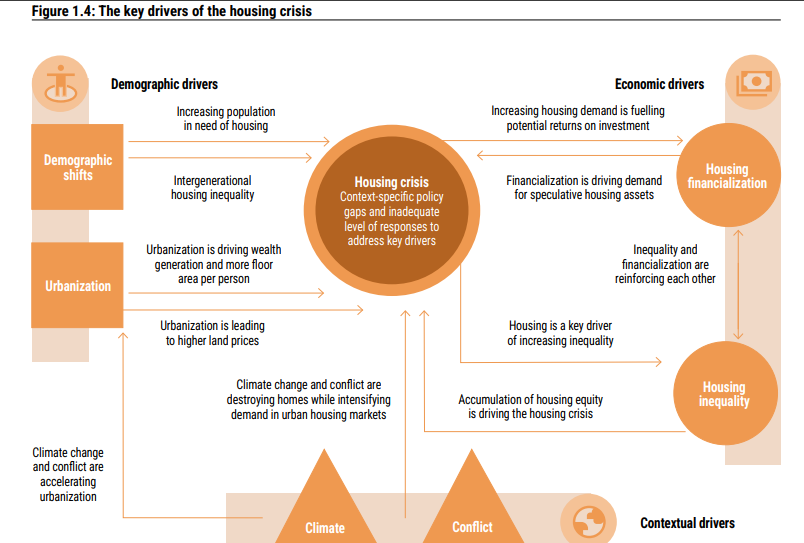
Key Drivers of the Global Housing Crisis
- Rapid Urbanisation: Large-scale migration towards cities has increased demand for housing faster than supply.
- Rising Land Prices: Escalating urban land prices have increased housing construction costs.
- Growing Inequality: Income inequality has reduced affordability for low and middle-income groups. Vulnerable groups such as migrants, women and informal workers are disproportionately affected.
- Financialisation of Housing: Housing is increasingly treated as an investment asset rather than a social necessity.
- Speculative investments and corporate ownership are pushing prices beyond the reach of ordinary households.
- Weak Housing Governance: Weak coordination between national and local governments affects implementation of housing policies.
- Many housing policies do not adequately address affordability, tenure security and sustainability.
Measures Suggested by the Report
- Treat Housing as a Public Priority: Governments should recognise housing as a social good and human right rather than only a market commodity.
- Upgrade Informal Settlements: Promote participatory in-situ slum upgrading instead of forced evictions.
- Strengthen Local Governments: Empower urban local bodies with financial and administrative capacity for housing delivery.
- Promote Climate-Resilient Housing: Encourage low-carbon construction materials and energy-efficient housing systems.
Initiatives Taken in India for Affordable Housing
- Valmiki Ambedkar Awas Yojana (VAMBAY): It was launched in 2001 by the Ministry of Urban Employment and Poverty Alleviation.
- The scheme focused on providing housing assistance to Below Poverty Line (BPL) urban slum dwellers.
- VAMBAY was later subsumed under the Jawaharlal Nehru National Urban Renewal Mission (JNNURM).
- Jawaharlal Nehru National Urban Renewal Mission (JNNURM): It was launched in 2005 as a seven-year flagship urban renewal programme. It operated through two major housing-related sub-missions:
- Basic Services to the Urban Poor (BSUP);
- Integrated Housing and Slum Development Programme (IHSDP).
- Rajiv Awas Yojana (RAY): It was launched in 2011 with the objective of creating a slum-free India.
- The scheme encouraged states to integrate slums into the formal urban system.
- Pradhan Mantri Awas Yojana (PMAY): It was launched in 2015 under the vision of “Housing for All. The scheme aims to provide affordable pucca houses with basic amenities to eligible urban and rural households. The scheme operates under two primary components:
- PMAY-Urban (PMAY-U 2.0) for cities and
- PMAY-Gramin (PMAY-G) for rural areas.
Concluding remarks
- The global housing crisis has emerged as one of the most significant urban development challenges of the 21st century.
- Rising urbanisation, inequality, unaffordable housing and climate change are intensifying vulnerabilities across the world.
- Addressing this crisis requires integrated urban planning, stronger public investment, inclusive housing policies and climate-resilient infrastructure.
Source: UN Habitat
Previous article
Sedition Trials can Go on if Accused is Willing: SC
